Skip to content

May 24, 2021 Deputy Editor-in-Chief of the magazine”Expert: Paradigm of Legal Sciences and Public Administration”, Director of the Research Center for Forensic Intellectual Property of the Ministry of Justice of Ukraine, prof. Vladislav Fedorenko took part in the International Conference of Rectors, Deans and Editors of Professional Legal Journals “New Directions and Challenges in Legal Scientific Communication” (“Nowe kierunki i wyzwania w prawniczej komunikacji naukowej”), organized and conducted by to the Scopus base) and the Law Interdisciplinary Research Center of the Leon Kozminski Academy in Warsaw (Republic of Poland).
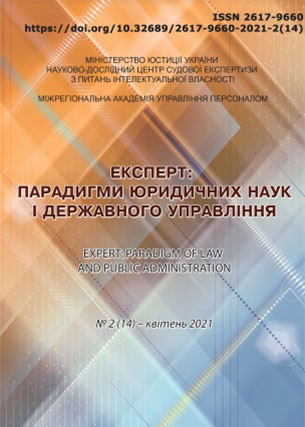
During the event, a professional (category B) on public administration and law magazine “Expert: Paradigm of Legal Sciences and Public Administration” was presented to the respected scientific community. The journal is published under the scientific guidance and with the assistance of the public scientific organization “Ukrainian Assembly of Doctors of Sciences in Public Administration”.
The organizer and moderator of the event was DrHb, prof. Yolanta Jablonska-Bonsa, who is the editor-in-chief of the journal Critique of Law and is a member of the editorial board of the electronic scientific publication Expert: Paradigms of Legal Sciences and Public Administration. Rector of the Leon Kozminski Academy in Warsaw DrHb, prof. Grzegorz Mazurek.
The conference participants discussed current issues of formation and publication of legal journals, indexation of scientific publications, integrity and quality of scientific articles, inclusion of journals in scientometric databases “Scopus” and “Web of Science” and others.
The Director of the Center V. Fedorenko, who is the Deputy Editor-in-Chief of the magazine “Expert: Paradigm of Legal Sciences and Public Administration” took part in the discussion and spoke about the experience of preventing plagiarism in legal journals in Ukraine. In particular, V. Fedorenko noted the following:
“One of the most dangerous obstacles to the development of science in Ukraine and abroad is plagiarism in scientific works – monographs, scientific articles, research reports, etc.
The phenomenon of plagiarism has been known to European civilization since ancient times. Contemporaries find borrowings in the works of Virgil, Herodotus, Plutarch from the works of other ancient historians. However, plagiarism in scientific works appeared much later. This was preceded by at least two factors:
1) the invention and industrial use of J. Guttenberg since 1450 of machine printing, its improvement through the invention of offset printing and “www-revolution” of XX-XXI centuries;
2) the separation of science from religion as a result of the Reformation and the “scientific revolution” in the XVII-XVIII centuries. and its rapid development through scientific works.
Availability and simplicity in the materialization of scientific works has created a temptation to misuse other people’s works or their fragments by unscrupulous scientists who seek to obtain:
a) moral satisfaction from the recognition by society of their scientific “achievements”;
b) assignment of scientific degrees and academic titles that contribute to the social status of their bearers;
c) obtaining material benefits through occupying relevant positions and receiving allowances for academic degrees and academic titles.
One of the universal, most accessible and, at the same time, obligatory types and forms of scientific works are articles in professional journals and collections of scientific articles. At the same time, the efficiency of publishing scientific articles in professional journals creates a problem of their quality and adherence to the principles of academic integrity.
In most journals in Ukraine, as in Poland and other Central and Eastern European countries, this problem is exacerbated by the fact that most experienced scientists seek to be published in journals classified as scientometric databases “Scopus” and “Web of Science”. However, in 2021, only one legal journal was included in the Scopus database in Ukraine – the Bulletin of the National Academy of Legal Sciences of Ukraine.
Accordingly, the editorial boards of legal scientific journals in Ukraine face problems in preventing plagiarism in scientific articles. First of all, in the qualification articles of graduate students, which are often written “on speed and quantity”.
Finally, it is important to further monitor and control the articles already published in the magazine for their quality and integrity, to provide feedback to the readership of the magazine, to discuss common issues of legal journals at the international level”.
The international conference was held online.


